Councilmanic Prerogative Goes on Trial
Councilmanic Prerogative On Trial
This week, the longstanding tradition gets tested in Federal court. Here's a better way to manage public assets
Councilmanic Prerogative On Trial
This week, the longstanding tradition gets tested in Federal court. Hither's a improve way to manage public assets
May. 10, 2016


The recent story in the Philadelphia Inquirer about the FBI probe into Philadelphia country deals could have been written at any number of times during the past half century. Every few years, cartons of files from housing and redevelopment agencies get hauled out of offices, but cases are rarely brought confronting agency staff or politicians.
There has ever been a deject over the disposition of the city's public land, and even over those existent estate projects that don't use public land but might crave the blessing of a local pol due to zoning or public subsidy considerations, like tax increment financing.
The cloud is there because they are political too as economical transactions. Fifty-fifty when in that location is naught wrong legally—and generally at that place is not—suspicion remains that the process is wired: that consideration is given to the continued more than to the value of the economical benefit for the metropolis. Or that projects are subject area to side deals to which only the developers and politicians are privy.
The upcoming Federal civil trial between real manor programmer Ori Feibush and Councilman Kenyatta Johnson, whom Feibush accuses of influencing the sale of property to campaign contributors, places and so-chosen councilmanic prerogative on trial. Feibush unsuccessfully ran against Johnson and is an active real manor developer in that District. He claims he was bypassed in public land transactions due to his political standing, non the value of his bid.
Kenyatta Johnson denies the claim and points to Feibush'south success in landing a great many projects in the District. Feibush says this was all prior to his decision to run for political part.
Nosotros do not know how the trial will turn out and certainly everything in the Feibush-Johnson feud has more than two sides to it. It is a political feud that reflects the divisions of a changing city and a irresolute neighborhood, in Point Breeze. Simply no matter whose side yous accept or what a jury decides, the accusations accept a familiar band to anyone involved in existent estate development in the city.
The ten councilpersons who represent specific parts of the urban center (versus the seven at-large council members) hold all the cards over the transfer of public real manor because legislation has to be introduced to motion state sales through the legislature and no councilperson will—by custom, non law—defy the volition of the local representative. This is the prerogative system that Feibush's case highlights.
A 2022 Pew study looked at 730 land use decisions over six years and found that Quango never voted against a Councilman'southward state transfer recommendations.
Councilmanic prerogative places enormous power into individual council hands, particularly for those parts of the city where real estate demand is growing and social conflicts grow over affordable versus market rate housing. Councilpersons become de facto existent estate brokers and social planners, all of which is field of study to perceived or actual conflicts of interest.
In 2022 a written report by Pew looked at 730 land use decisions over half dozen years and found that Council never voted confronting a councilman's land transfer recommendations; in fact, all but iv of the 730 transactions were unanimous.
The public land system rarely results in corruption trials or fifty-fifty ceremonious suits. The evidence is simply not there, because it's a organization that works more by assumption and custom than past bribes or explicit quid pro quos. But abuse is not the issue—despite what the FBI finds about any particular transaction. The bigger issue is the fact that political influence results in an economically sub-optimal system that does not create the public wealth nosotros need to support public services.
How does the system brusk its citizens? By slowing downward the procedure of legitimate evolution; past holding back parcels for auction without the need to explain why; by assuasive the poor condition of vacant lots and properties to bleed value from neighboring housing units, and by allowing properties to sell for less than market place value in a metropolis starved for revenue.
This is all done with a sure sense of paternalism: Councilperson knows best. As Council President Darrell Clarke said in the Pew written report, "Who knows their District better than the Councilperson?" Whether residents demand to exist taken care of by a political overseer raises lots of questions. Can't citizens act on their own behalf? Should economic versus political considerations exist more explicitly emphasized in managing public assets? When elected officials function as dealmakers can they also deed equally representatives of the broad public interest?
The politicization of land disposition besides brings with it a horde of lobbyists, consultants, lawyers, and other middlemen who extract a fee for knowing how to manage the political organisation. They become a necessary cost to a dysfunctional organization. An entire industry has been launched over decades filled with people who know more most subsidy programs and real estate politics than nearly how to build or rehabilitate a business firm or commercial space. This transfers the action from the arts and crafts of edifice to the craft of political management and manipulation.
The introduction of a State Banking company as a manner to rationalize the process of public land disposition did zero to modify the political calculus that every for-profit and nonprofit developer makes: Continue your Councilperson happy or the land volition not move in your direction. Nor did a much-improved zoning code and a more professional zoning lath alter the terms of the game. They were terrific reforms—particularly a new zoning lawmaking that abrogated the need for an obsessive number of variances, which always politicized the process—but they are incomplete without farther steps toward professional direction of the development procedure.
Quango influence remains baked into both the State Bank and zoning procedure. The sale of belongings endemic by the Philadelphia Country Depository financial institution must be approved by Urban center Council. When information technology comes to the State Depository financial institution, never before has more than fuss been made over a new mechanism that does zippo to alter the basic way business organisation is done. Yes, information technology may make more than rational the parcels of the 4 public agencies that hold land, but it will not de-politicize country sales.
Councilmanic Prerogative is almost never about a directly quid pro quo. It is much more about the general atmosphere that exists to get anything washed: Make entrada contributions, piece of work with the Councilperson's favored borough groups, provide certain targeted customs benefits, hire sure contractors, piece of work with sure marriage leaders.
Councilmanic prerogative represents the limit to the reform of land development. Information technology creates a patron-client system and thereby blocks the application of more than professional standards. The council people in charge are the patrons and those that want to bid on land are the clients. Not the customers, mind you, but the clients. Non the citizens, but the clients.
The seven at-large Councilpersons have no continuing in whatsoever of this. If they interfere with the system then their capacity to go annihilation washed in Council erodes. They get reduced to belongings hearings without being able to introduce legislation of any outcome. They become political dilettantes, while the real action is in the district seats.
The privilege of Council is almost never about a direct quid pro quo and hence information technology is perfectly legal. It is much more than about the full general temper that exists to get anything done: Make campaign contributions, piece of work with the Councilperson'southward favored civic groups, provide sure targeted customs benefits, hire certain contractors, work with certain union leaders. It never has to be said directly.
And then what can we do almost it? Outset, we have to link this effect to other policy questions and choices that are existence discussed. The city is in a tizzy over the sugary beverage tax, which the Mayor has linked to his commendable goal of providing universal pre-K. But to beget the early childhood education programs he needed to raise money through a new taxation.
And then nosotros have to ask whether, rather than raise taxes, nosotros can identify other ways to generate money from what we already ain and control. Taxes and fees are one way to raise coin but some other is to increase the value of public avails. That is where our odd way of managing publicly owned real estate enters the conversation. What if we redesigned the system in a dramatically new way: Could we make full budget gaps?
In a previous cavalcade I mentioned a contempo volume by Dag Detter and Stefan Folster entitled: The Public Wealth of Nations: How Management of Public Assets Can Boom or Bust Economic Growth. The book has stirred a bully deal of interest because it provides a tertiary way of thinking nearly public nugget management distinct from straight authorities management or full privatization. This calendar week I will attend a small conference at the Brookings Institution with one of the authors defended to their thesis and its applicability in the United States.
Let me try to outline a few of their points and and so bring it back to the Philadelphia situation. Detter and Folster make the following claims:
- The largest owner of wealth in nearly every nation is the public sector
- Most governments have very limited knowledge of the extent or value of their own holdings in everything ranging from commercial existent manor to country endemic enterprises to transport and utilities
- The near important consequence we have to face up is not whether to privatize an asset or accept public ownership simply, rather, the quality of public governance
- The right kind of public wealth management tin generate significant economic value to cities and nations, particularly at a time when so many governments are overloaded with debt and cannot balance their budgets
- The ideal public wealth direction organisation disconnects government from direct asset management and substitutes a professional arrangement answerable to return principles and other market forms of accountability
- The organizing principle for public wealth management ought to be value creation and growth, although that tin include social outcomes structured into the portfolio expectations
Like anyone trying to solve big bug of public concern, Detter and Foster grapple with how to best integrate private sector value creation with public purpose. They understand that neither direct authorities control nor the wrong kind of privatization (which then often leads to the worst of crony capitalism) is the easy answer. Moreover, the integration of the two forces often has the incorrect consequences, equally nosotros saw with Fannie Mae eight years ago.
The book uses a variety of examples from around the world to bear witness what works and what does not. What emerges is a notion of public nugget governance that would depict heavily from the private sector—professional managers, expert board members, transparency, proper accounting, expectations of returns—simply at the same fourth dimension is managed on behalf of the citizens of a urban center, region, or nation.
Nosotros have to ask whether, rather than enhance taxes, nosotros tin can identify other means to generate money from what we already own and command. Can we increment the value of public assets? What if we redesigned the system in a dramatically new fashion: Could we fill budget gaps?
I am providing a necessarily abbreviated review of their statement. Just the important point is that they recognize that we have undervalued public assets and that revaluing them tin assist solve budgetary problems, increase gross production, and build long-term public wealth. But the key ingredient in getting this washed is to shift our notion of governance from those that emerged during industrial and post-industrial (privatization) capitalism. The former favored a system of centralized government command, while the latter valued privatization.
The big idea here is the distinction between government as a realm of democracy versus government as a directly nugget manager. To the authors, the right strategy is i that frees politicians to practise the existent work of commonwealth, which, in part, has to do with maintaining citizen accountability effectually the management of the assets, not managing those assets direct. Or in their words, making politicians into the right kind of consumer advocates.
So dorsum to the Philadelphia example. What if we were to blow the whole state sales procedure up and create a professionally managed corporation without political interference that controlled all metropolis land with commercial value (exterior of parks and other sites of collective utilize)? All of the planning, zoning, and ecology safeguards would nonetheless adhere. And we could ascribe target goals for value creation and cash returns back to the city budget. We could also accredit some equity goals as part of the management process.
What would happen? Kickoff, nosotros would go an actual accounting of the value and holdings of public property but to build a baseline. Secondly, we would speed up the process because we no longer would manage through a politicized City Quango system of influence. Third, the citizens of the city could read—similar real shareholders—an annual study of the commercial real estate visitor that manages on their behalf. Fourth, nosotros would be able to trace the returns of that company back to the city budget.
Impossible? Perhaps. But if we want to break the chokehold of 20th century ideologies on our imaginations and budgets, we had amend rethink this stuff. Information technology is not just a thing of whether the FBI snares another Philadelphia politician. We tin be sure that they eventually volition. It is a matter of whether nosotros can build systems of governance that limit the opportunity for public corruption and maximize the returns on our public assets to their shareholders—the citizens.
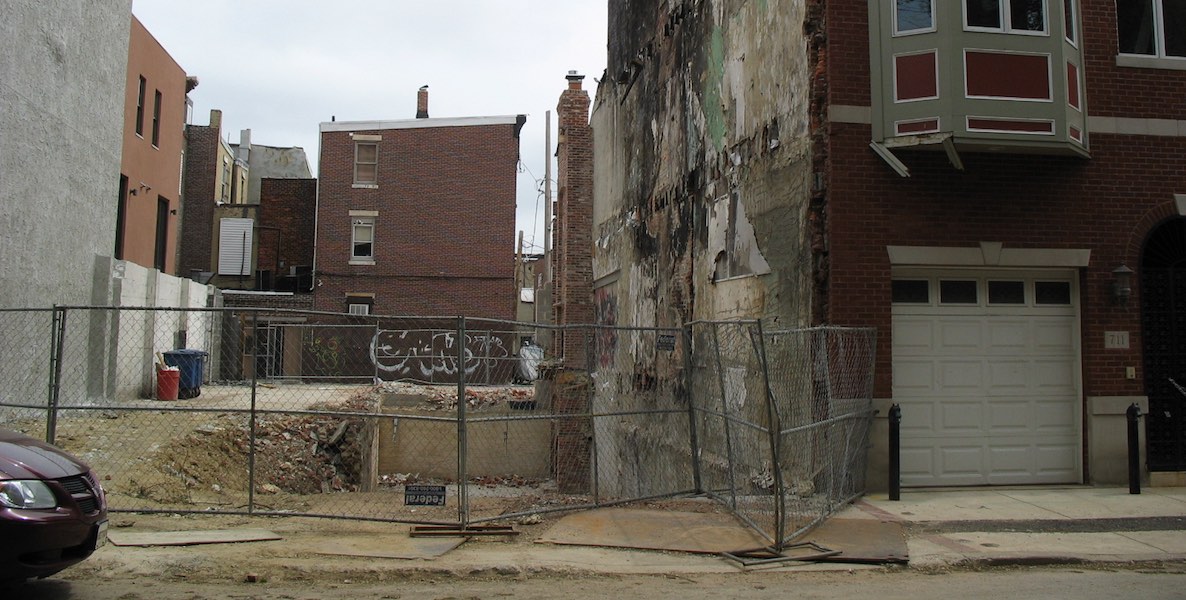
Photograph Header: Flickr/teofilo

Source: https://thephiladelphiacitizen.org/councilmanic-prerogative-philadelphia/
0 Response to "Councilmanic Prerogative Goes on Trial"
Post a Comment