State to fight lawsuit by low-income students
 Credit: Susan Frey/EdSource Today
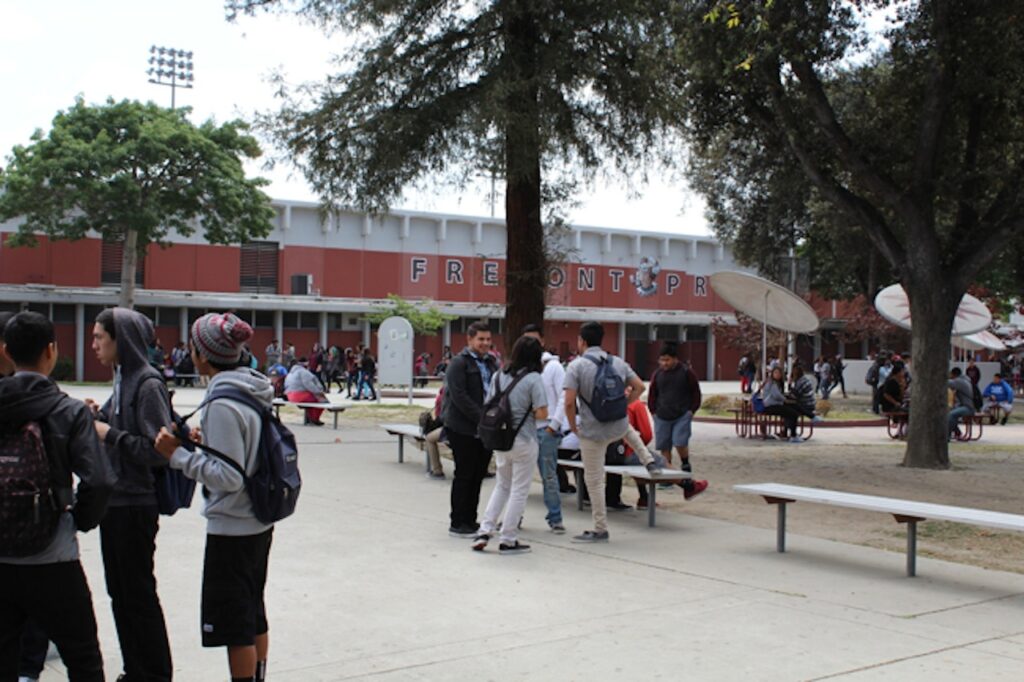
Fremont High Schoolhouse in Los Angeles is one of the schools named in Cruz v. California
State finance officials last calendar week granted the California Department of Teaching $3.four million to fight a lawsuit that demands the state fix confusing conditions in some high-poverty schools where students allegedly are beingness denied the primal correct to an education.
The lawsuit claims that some students are enrolled in multiple classes during which they receive no instruction, that some spend hours in security lockdowns, and that teachers and students are reeling from the trauma of violent shootings around campuses.
The Department of Didactics will hire outside lawyers at $450 an hour to defend itself confronting the class-action lawsuit filed on behalf of Jessy Cruz, a pupil at Fremont High School in Los Angeles, and more than a dozen other students at eight schools in 4 unified school districts: Los Angeles, Compton, Oakland and Due west Contra Costa.
The adapt, Cruz v. California, pits the land constitutional guarantee of equal educational opportunity confronting local school district command over how to spend state funds, which is the foundation of the new school finance reforms known equally the Local Command Funding Formula.
The example is at to the lowest degree the third lawsuit in which the state has argued information technology is not required to intervene in districts to ensure equal educational opportunity. In two previous major cases, the state lost, either in court or in a settlement understanding.
"As a legal matter, my view is the land is on pretty thin ice by saying it isn't their responsibility," said William Koski, a Stanford Constabulary School professor.
"As a legal matter, my view is the state is on pretty thin ice by maxim it isn't their responsibility," said William Koski, a professor of law and education at Stanford Law Schoolhouse.
Margaret Russell, a law professor at Santa Clara University School of Law, said, "It'south a weak argument for them to say it is only the district'south responsibility and not the role of the state."
In Butt v. California, brought by parent Thomas Barrel in the Richmond Unified School District, the California Supreme Court ruled in 1992 that "the State itself is responsible for the 'fundamental' educational rights of California students and must remedy a local commune's disability to provide its students an education 'basically equivalent' to that provided elsewhere in the State."
In a landmark 2004 settlement understanding in Williams v. California, brought on behalf of San Francisco student Eliezer Williams, the state was held responsible for ensuring, through a monitoring organization, that all students have textbooks, qualified teachers and safe facilities – buildings without leaks or rodents.
"It'southward the Williams example all once more," Bernard James, a law professor at Pepperdine University School of Law, said of Cruz v. California. "The broad outlines of both cases are on the topic of an equal opportunity to acquire."
The California Department of Didactics said this week it could non comment on the litigation, but in statements and legal briefs, the department has expressed its belief that local solutions, not state interventions, are required.
"We believe continuing to implement California's Local Command Funding Formula – rather than shifting authority to Sacramento – is the best style to better student achievement and meet the needs of our schools," said Country Superintendent of Public Instruction Tom Torlakson and State Board of Pedagogy President Michael Kirst in a argument when Cruz v. California was filed in May. "Nosotros will resist any effort to derail this important initiative through costly and unnecessary litigation."
The American Ceremonious Liberties Union of Southern California, pro bono law firm Public Counsel and the police force firms Carlton Fields Jorden Burt and Arnold & Porter filed the accommodate on behalf of the students.
In a Dec. 9 alphabetic character to legislative leaders, the California Department of Finance stated that it had approved a request from the Section of Education for $3,375,000 to be paid in this current fiscal yr to hire outside lawyers for the Cruz instance. The California attorney general, the Section of Teaching and the State Board of Teaching agreed the expense was necessary, according to the Section of Finance alphabetic character.
"I didn't think you lot'd take to go to court in 2022 to argue that students demand to become to schools where they have courses that have content," said Mark Rosenbaum, an chaser at Public Counsel. "The state'southward position, and I'm not exaggerating, is 'We have no duty.'"
Cruz v. California alleges that the students named in the complaint have been denied pregnant amounts of state-mandated instructional time at viii schools: Thomas Jefferson High Schoolhouse, John C. Fremont High School and Florence Griffith Joyner Elementary School in Los Angeles; Castlemont High School and Fremont High School in Oakland; Franklin Southward. Whaley Center School and Compton High Schoolhouse in Compton; and Nystrom Elementary Schoolhouse in W Contra Costa.
The lawsuit states that at the high schools named, instead of attending classes to meet graduation and college entrance requirements, the students are assigned to many periods of "habitation," "service" or "library" classes that accept no academic instruction. During those periods, students are going abode, walking effectually campus or photocopying papers for teachers, according to the complaint. The arrange claims a lack of bachelor, qualified teachers and a shortage of course offerings at the schools are to blame.
Other causes of lost instructional time, the suit alleges, include violent incidents. In i instance in April 2013, bullets were shot through the front door of Oakland's Castlemont Loftier School and into the main hallway, where students were walking.
Teachers quitting their jobs mid-year also interferes with instruction. The lawsuit cites the example of a teacher at Nystrom Elementary Schoolhouse in Richmond who was so overwhelmed by the lack of resource and back up that she chosen 911 from her classroom during the school twenty-four hours "to report she was a danger to herself." Constabulary escorted her from the classroom. A teacher with no prior didactics feel was hired to replace her, the suit said.
The situations causing students to miss out on curriculum and academic engagement are known to the California Section of Education but "hidden from view for the majority of the public, who would be balked were fifty-fifty some of these atmospheric condition to have identify in their children's schools," the lawsuit alleges.
As part of the case, Alameda County Superior Courtroom Judge George Hernandez Jr. issued a temporary restraining order in October instructing the California Section of Educational activity to intervene at Jefferson High School in Los Angeles, where some students had spent eight weeks in classes without instruction. Hernandez said the state of affairs was causing "severe and pervasive educational deprivations."
In a legal brief filed in opposition to the request for the temporary restraining club, Robin Johansen, an attorney with Remcho, Johansen & Purcell, which is representing the Department of Education, best-selling that the alleged bug at Jefferson High warranted a response but "that response and appropriate remedies, however, should come at the school site and school-district level."
David Sapp, an attorney at the American Civil Liberties Wedlock of Southern California, noted that the land, under Gov. Gray Davis, spent four years fighting the Williams example at a price of $22 1000000 in exterior attorney fees. Additionally, the state had to pay $20 million in fees for the opposition attorneys as part of the settlement.
At present in the Cruz instance, Sapp said, "They are choosing to spend discretionary money to fight this lawsuit instead of doing what's right."
To get more than reports like this 1, click here to sign up for EdSource's no-cost daily email on latest developments in didactics.
Source: https://edsource.org/2014/state-to-fight-lawsuit-by-impoverished-students/71673
0 Response to "State to fight lawsuit by low-income students"
Post a Comment