First Great Awakening Free Dolphins Teacher Miss Smith for the Weather Again
The First Great Awakening (sometimes Corking Enkindling) or the Evangelical Revival was a series of Christian revivals that swept Great britain and its thirteen North American colonies in the 1730s and 1740s. The revival movement permanently affected Protestantism as adherents strove to renew individual piety and religious devotion. The Bully Awakening marked the emergence of Anglo-American evangelicalism as a trans-denominational movement within the Protestant churches. In the United states, the term Peachy Awakening is most often used, while in the Britain the motility is referred to as the Evangelical Revival.[one]
Building on the foundations of older traditions—Puritanism, Pietism and Presbyterianism—major leaders of the revival such as George Whitefield, John Wesley and Jonathan Edwards articulated a theology of revival and salvation that transcended denominational boundaries and helped forge a common evangelical identity. Revivalists added to the doctrinal imperatives of Reformation Protestantism an emphasis on providential outpourings of the Holy Spirit. Extemporaneous preaching gave listeners a sense of deep personal confidence of their need of salvation by Jesus Christ and fostered introspection and commitment to a new standard of personal morality. Revival theology stressed that religious conversion was not merely intellectual assent to correct Christian doctrine but had to exist a "new nativity" experienced in the heart. Revivalists also taught that receiving balls of conservancy was a normal expectation in the Christian life.
While the Evangelical Revival united evangelicals beyond various denominations effectually shared behavior, information technology also led to segmentation in existing churches between those who supported the revivals and those who did non. Opponents accused the revivals of fostering disorder and fanaticism inside the churches by enabling uneducated, itinerant preachers and encouraging religious enthusiasm. In England, evangelical Anglicans would grow into an important constituency within the Church of England, and Methodism would develop out of the ministries of Whitefield and Wesley. In the American colonies the Enkindling caused the Congregational and Presbyterian churches to split up, while it strengthened both the Methodist and Baptist denominations. It had little immediate bear on on well-nigh Lutherans, Quakers, and non-Protestants,[2] simply afterwards gave rising to a schism amidst Quakers (see History of the Quakers) which persists to this day.
Evangelical preachers "sought to include every person in conversion, regardless of gender, race, and status".[three] Throughout the Northward American colonies, especially in the South, the revival motion increased the number of African slaves and free blacks who were exposed to and subsequently converted to Christianity.[4] Information technology also inspired the founding of new missionary societies, such equally the Baptist Missionary Club in 1792.[v]
Continental Europe [edit]
Historian Sydney Due east. Ahlstrom sees the Great Awakening equally part of a "neat international Protestant upheaval" that besides created pietism in the Lutheran and Reformed churches of continental Europe.[6] Pietism emphasized heartfelt religious religion in reaction to an overly intellectual Protestant scholasticism perceived as spiritually dry. Significantly, the pietists placed less emphasis on traditional doctrinal divisions between Protestant churches, focusing rather on religious experience and affections.[7]
Pietism prepared Europe for revival, and it usually occurred in areas where pietism was strong. The virtually important leader of the Awakening in central Europe was Nicolaus Zinzendorf, a Saxon noble who studied under pietist leader August Hermann Francke at Halle University.[8] In 1722, Zinzendorf invited members of the Moravian Church to live and worship on his estates, establishing a community at Herrnhut. The Moravians came to Herrnhut every bit refugees, but under Zinzendorf'south guidance, the group enjoyed a religious revival. Presently, the customs became a refuge for other Protestants too, including German Lutherans, Reformed Christians and Anabaptists. The church began to grow, and Moravian societies would be established in England where they would assist foster the Evangelical Revival also.[9]
Evangelical Revival in Great britain [edit]
England [edit]
While known equally the Great Awakening in the United States, the movement is referred to as the Evangelical Revival in Britain.[i] [10] In England, the major leaders of the Evangelical Revival were three Anglican priests, the brothers John and Charles Wesley and their friend George Whitefield. Together, they founded what would go Methodism. They had been members of a religious club at Oxford University called the Holy Club and "Methodists" due to their methodical piety and rigorous asceticism. This social club was modeled on the collegia pietatis (cell groups) used by pietists for Bible report, prayer and accountability.[11] [12] All three men experienced a spiritual crisis in which they sought true conversion and assurance of organized religion.[10]
George Whitefield joined the Holy Club in 1733 and, under the influence of Charles Wesley, read German language pietist August Hermann Francke's Confronting the Fear of Man and Scottish theologian Henry Scougal's The Life of God in the Soul of Man (the latter work was a favorite of Puritans). Scougal wrote that many people mistakenly understood Christianity to be "Orthodox Notions and Opinions" or "external Duties" or "rapturous Heats and extatic Devotion". Rather, Scougal wrote, "Truthful Religion is an Union of the Soul with God . . . Information technology is Christ formed within u.s.."[13] Whitefield wrote that "though I had fasted, watched and prayed, and received the Sacrament long, still I never knew what true organized religion was" until he read Scougal.[thirteen] From that point on, Whitefield sought the new birth. After a menstruum of spiritual struggle, Whitefield experienced conversion during Lent in 1735.[14] [15] In 1736, he began preaching in Bristol and London.[xvi] His preaching attracted large crowds who were drawn to his simple message of the necessity of the new nativity equally well as by his mode of delivery. His way was dramatic and his preaching appealed to his audience'southward emotions. At times, he wept or impersonated Bible characters. By the fourth dimension he left England for the colony of Georgia in December 1737, Whitefield had become a celebrity.[17]
John Wesley left for Georgia in Oct 1735 to become a missionary for the Society for Promoting Christian Knowledge. Wesley made contact with members of the Moravian Church led by Baronial Gottlieb Spangenberg. Wesley was impressed by their religion and piety, especially their belief that information technology was normal for a Christian to take assurance of organized religion. The failure of his mission and encounters with the Moravians led Wesley to question his ain faith. He wrote in his journal, "I who went to America to convert others was never myself converted to God."[18]
Back in London, Wesley became friends with Moravian minister Peter Boehler and joined a Moravian small group called the Fetter Lane Order.[19] In May 1738, Wesley attended a Moravian meeting on Aldersgate Street where he felt spiritually transformed during a reading of Martin Luther'due south preface to the Epistle to the Romans. Wesley recounted that "I felt my heart strangely warmed. I felt I did trust in Christ, Christ alone for conservancy, and an assurance was given me that he had taken away my sins, fifty-fifty mine, and saved me from the police of sin and death."[xx] Wesley understood his Aldersgate experience to be an evangelical conversion, and it provided him with the assurance he had been seeking. Afterwards, he traveled to Herrnhut and met Zinzendorf in person.[19]
John Wesley returned to England in September 1738. Both John and Charles were preaching in London churches. Whitefield stayed in Georgia for three months to establish Bethesda Orphanage before returning to England in December.[21] While enjoying success, Whitefield's afoot preaching was controversial. Many pulpits were airtight to him, and he had to struggle confronting Anglicans who opposed the Methodists and the "doctrine of the New Birth". Whitefield wrote of his opponents, "I am fully convinced there is a fundamental deviation between united states and them. They believe merely an outward Christ, nosotros further believe that He must be inwardly formed in our hearts as well."[22]
In February 1739, parish priests in Bath and Bristol refused to allow Whitefield to preach in their churches on the grounds that he was a religious enthusiast.[23] In response, he began open up-air field preaching in the mining community of Kingswood, virtually Bristol.[22] Open-air preaching was common in Wales, Scotland and Northern Ireland, simply it was unheard of in England. Further, Whitefield violated protocol by preaching in another priest'south parish without permission.[12] Inside a week, he was preaching to crowds of 10,000. Past March, Whitefield had moved on to preach elsewhere. By May, he was preaching to London crowds of l,000. He left his followers in Bristol in the intendance of John Wesley.[24] [23] Whitefield's notoriety was increased through the use of newspaper advertisements to promote his revivals.[25] Wesley was at kickoff uneasy about preaching outdoors, as it was contrary to his high-church sense of decency. Somewhen, however, Wesley inverse his mind, claiming that "all the world [is] my parish".[12] On April 2, 1739, Wesley offset preached to about 3,000 people near Bristol.[26] From then on he continued to preach wherever he could get together an assembly, taking the opportunity to recruit followers to the motility.[27]
Faced with growing evangelistic and pastoral responsibilities, Wesley and Whitefield appointed lay preachers and leaders.[28] Methodist preachers focused particularly on evangelising people who had been "neglected" by the established Church of England. Wesley and his assistant preachers organised the new converts into Methodist societies.[28] These societies were divided into groups chosen classes—intimate meetings where individuals were encouraged to confess their sins to i another and to build each other up. They as well took part in dear feasts which allowed for the sharing of testimony, a central feature of early on Methodism.[29] Growth in numbers and increasing hostility impressed upon the revival converts a deep sense of their corporate identity.[28] Three teachings that Methodists saw as the foundation of Christian organized religion were:
- People are all, by nature, "dead in sin".
- They are "justified by organized religion solitary"
- Faith produces inward and outward holiness.[30]
The evangelicals responded vigorously to opposition—both literary criticism and even mob violence[31]—and thrived despite the attacks against them.[31] [32] John Wesley'south organisational skills during and subsequently the peak of revivalism established him as the primary founder of the Methodist move. Past the fourth dimension of Wesley's death in 1791, in that location were an estimated 71,668 Methodists in England and 43,265 in America.[15]
Wales and Scotland [edit]
The Evangelical Revival get-go broke out in Wales. In 1735, Howell Harris and Daniel Rowland experienced a religious conversion and began preaching to large crowds throughout South Wales. Their preaching initiated the Welsh Methodist revival.[10]
The origins of revivalism in Scotland stretch back to the 1620s.[33] The attempts by the Stuart Kings to impose bishops on the Church of Scotland led to national protests in the course of the Covenanters. In addition, radical Presbyterian clergy held outdoor conventicles throughout southern and western Scotland centering on the communion flavour. These revivals would too spread to Ulster and featured "marathon ad-lib preaching and excessive pop enthusiasm."[34] In the 18th century, the Evangelical Revival was led by ministers such as Ebenezer Erskine, William M'Culloch (the minister who presided over the Cambuslang Work of 1742), and James Robe (minister at Kilsyth).[xv] A substantial number of Church building of Scotland ministers held evangelical views.[35]
Slap-up Awakening in North America [edit]
Early revivals [edit]
In the early on 18th century, the xiii Colonies were religiously diverse. In New England, the Congregational churches were the established religion; whereas in the religiously tolerant Middle Colonies, the Quakers, Dutch Reformed, Anglican, Presbyterian, Lutheran, Congregational, and Baptist churches all competed with each other on equal terms. In the Southern colonies, the Anglican church was officially established, though there were significant numbers of Baptists, Quakers and Presbyterians.[36] At the same time, church membership was low from having failed to keep upwards with population growth, and the influence of Enlightenment rationalism was leading many people to turn to atheism, Deism, Unitarianism and Universalism.[37] The churches in New England had fallen into a "staid and routine formalism in which experiential faith had been a reality to only a scattered few."[38]
In response to these trends, ministers influenced by New England Puritanism, Scots-Irish Presbyterianism, and European Pietism began calling for a revival of organized religion and piety.[37] [39] The blending of these 3 traditions would produce an evangelical Protestantism that placed greater importance "on seasons of revival, or outpourings of the Holy Spirit, and on converted sinners experiencing God's dear personally."[40] In the 1710s and 1720s, revivals became more frequent among New England Congregationalists.[41] These early revivals remained local affairs due to the lack of coverage in print media. The starting time revival to receive widespread publicity was that precipitated by an earthquake in 1727. As they began to exist publicized more than widely, revivals transformed from merely local to regional and transatlantic events.[42]
In the 1720s and 1730s, an evangelical political party took shape in the Presbyterian churches of the Middle Colonies led by William Tennent, Sr. He established a seminary called the Log Higher where he trained nearly 20 Presbyterian revivalists for the ministry, including his iii sons and Samuel Blair.[43] While pastoring a church in New Jersey, Gilbert Tennent became acquainted with Dutch Reformed minister Theodorus Jacobus Frelinghuysen. Historian Sydney Ahlstrom described Frelinghuysen equally "an important herald, if not the father of the Cracking Awakening".[43] A pietist, Frelinghuysen believed in the necessity of personal conversion and living a holy life. The revivals he led in the Raritan Valley were "forerunners" of the Great Awakening in the Middle Colonies. Under Frelinghuysen'south influence, Tennent came to believe that a definite conversion feel followed by assurance of salvation was the key marker of a Christian. By 1729, Tennent was seeing signs of revival in the Presbyterian churches of New Brunswick and Staten Island. At the same time, Gilbert's brothers, William and John, oversaw a revival at Freehold, New Bailiwick of jersey.[44]
Northampton revival [edit]

The about influential evangelical revival was the Northampton revival of 1734–1735 nether the leadership of Congregational minister Jonathan Edwards.[45] In the fall of 1734, Edwards preached a sermon series on justification by faith lone, and the community's response was extraordinary. Signs of religious commitment among the laity increased, especially among the town's young people. Edwards wrote to Boston minister Benjamin Colman that the town "never was so full of Love, nor and so full of Joy, nor so total of distress as it has lately been. ... I never saw the Christian spirit in Love to Enemies and then exemplified, in all my Life as I take seen it within this one-half-year."[46] The revival ultimately spread to 25 communities in western Massachusetts and central Connecticut until information technology began to wane in 1737.[47]
At a time when Enlightenment rationalism and Arminian theology was popular amid some Congregational clergy, Edwards held to traditional Calvinist doctrine. He understood conversion to be the experience of moving from spiritual deadness to joy in the cognition of 1'south election (that one had been chosen past God for conservancy). While a Christian might take several conversion moments as part of this process, Edwards believed there was a single point in fourth dimension when God regenerated an individual, even if the exact moment could not be pinpointed.[48]
The Northampton revival featured instances of what critics called enthusiasm just what supporters believed were signs of the Holy Spirit. Services became more emotional and some people had visions and mystical experiences. Edwards cautiously dedicated these experiences every bit long as they led individuals to a greater belief in God'southward celebrity rather than in self-glorification. Like experiences would appear in well-nigh of the major revivals of the 18th century.[49]
Edwards wrote an account of the Northampton revival, A Faithful Narrative, which was published in England through the efforts of prominent evangelicals John Guyse and Isaac Watts. The publication of his account made Edwards a celebrity in United kingdom and influenced the growing revival movement in that nation. A Faithful Narrative would go a model on which other revivals would be conducted.[50]
Whitefield, Tennent and Davenport [edit]
George Whitefield kickoff came to America in 1738 to preach in Georgia and plant Bethesda Orphanage. Whitefield returned to the Colonies in November 1739. His first cease was in Philadelphia where he initially preached at Christ Church building, Philadelphia'south Anglican church, and and then preached to a big outdoor oversupply from the courthouse steps. He then preached in many Presbyterian churches.[51] From Philadelphia, Whitefield traveled to New York then to the Southward. In the Middle Colonies, he was pop in the Dutch and High german communities as well equally amid the British. Lutheran pastor Henry Muhlenberg told of a German language woman who heard Whitefield preach and, though she spoke no English, afterward said she had never before been so edified.[52]
In 1740, Whitefield began touring New England. He landed in Newport, Rhode Island, on September fourteen, 1740, and preached several times in the Anglican church. He then moved on to Boston, Massachusetts, where he spent a week. There were prayers at King's Chapel (at the time an Anglican church) and preaching at Brattle Street Church building and South Church.[53] On September 20, Whitefield preached in Commencement Church building and then outside of information technology to most 8,000 people who could not gain entrance. The side by side day, he preached outdoors once again to about 15,000 people.[54] On Tuesday, he preached at 2d Church building and on Wednesday at Harvard University. Afterwards traveling as far as Portsmouth, New Hampshire, he returned to Boston on October 12 to preach to xxx,000 people before continuing his tour.[53]
Whitefield then traveled to Northampton at the invitation of Jonathan Edwards. He preached twice in the parish church building while Edwards was then moved that he wept. He so spent fourth dimension in New Haven, Connecticut, where he preached at Yale University. From there he traveled down the coast, reaching New York on October 29. Whitefield's assessment of New England's churches and clergy prior to his intervention was negative. "I am verily persuaded," he wrote, "the Generality of Preachers talk of an unknown, unfelt Christ. And the Reason why Congregations accept been and so dead, is because dead Men preach to them."[53]
Whitefield met Gilbert Tennent on Staten Isle and asked him to preach in Boston to continue the revival at that place. Tennent accepted and in Dec began a 3-calendar month long preaching tour throughout New England. Besides Boston, Tennent preached in towns throughout Massachusetts, Rhode Island and Connecticut. Like Whitefield's, Tennent'southward preaching produced large crowds, many conversions and much controversy. While antirevivalists such every bit Timothy Cutler heavily criticized Tennent's preaching, most of Boston's ministers were supportive.[55]
Tennent was followed in the summertime of 1741 past itinerant minister James Davenport, who proved to be more than controversial than either Tennent or Whitefield. His rants and attacks against "unconverted" ministers inspired much opposition, and he was arrested in Connecticut for violating a law confronting itinerant preaching. At his trial, he was found mentally sick and deported to Long Isle. Before long later on, he arrived in Boston and resumed his fanatical preaching only to over again be declared insane and expelled. The last of Davenport's radical episodes took place in March 1743 in New London when he ordered his followers to burn wigs, cloaks, rings and other vanities. He likewise ordered the called-for of books by religious authors such every bit John Flavel and Increase Mather.[55] Following the intervention of two pro-revival "New Light" ministers, Davenport's mental state apparently improved, and he published a retraction of his before excesses.[56]
Whitefield, Tennent and Davenport would be followed by a number of both clerical and lay itinerants. However, the Enkindling in New England was primarily sustained past the efforts of parish ministers. Sometimes revival would be initiated past regular preaching or the customary pulpit exchanges between 2 ministers. Through their efforts, New England experienced a "great and general Awakening" between 1740 and 1743 characterized by a greater interest in religious experience, widespread emotional preaching, and intense emotional reactions accompanying conversion, including fainting and weeping.[56] There was a greater emphasis on prayer and devotional reading, and the Puritan platonic of a converted church membership was revived. It is estimated that between 20,000 and fifty,000 new members were admitted to New England'south Congregational churches fifty-fifty as expectations for members increased.[38]
By 1745, the Enkindling had begun to wane. Revivals would continue to spread to the southern backcountry and slave communities in the 1750s and 1760s.[37]
Conflict [edit]

Philadelphia's 2d Presbyterian Church, ministered by New Light Gilbert Tennent, was built betwixt 1750 and 1753 after the separate between Old and New Side Presbyterians.
The Great Enkindling aggravated existing conflicts inside the Protestant churches, oft leading to schisms betwixt supporters of revival, known as "New Lights", and opponents of revival, known every bit "Quondam Lights". Old Lights saw the religious enthusiasm and itinerant preaching unleashed past the Awakening every bit disruptive to church order, preferring formal worship and a settled, university-educated ministry building. They mocked revivalists as being ignorant, heterodox or con artists. New Lights defendant Onetime Lights of being more concerned with social condition than with saving souls and even questioned whether some Erstwhile Light ministers were even converted. They also supported afoot ministers who disregarded parish boundaries.[37] [57]
Congregationalists in New England experienced 98 schisms, which in Connecticut also affected which group would be considered "official" for tax purposes. It is estimated in New England that in the churches there were near one-third each of New Lights, Onetime Lights, and those who saw both sides as valid.[58] The Enkindling angry a wave of separatist feeling within the Congregational churches of New England. Effectually 100 Separatist congregations were organized throughout the region by Strict Congregationalists. Objecting to the Halfway Covenant, Strict Congregationalists required testify of conversion for church membership and as well objected to the semi–presbyterian Saybrook Platform, which they felt infringed on congregational autonomy. Because they threatened Congregationalist uniformity, the Separatists were persecuted and in Connecticut they were denied the same legal toleration enjoyed past Baptists, Quakers and Anglicans.[59]
The Baptists benefited the near from the Keen Awakening. Numerically small before the outbreak of revival, Baptist churches experienced growth during the last half of the 18th century. By 1804, there were over 300 Baptist churches in New England. This growth was primarily due to an influx of former New Light Congregationalists who became convinced of Baptist doctrines, such as believer's baptism. In some cases, entire Separatist congregations accustomed Baptist behavior.[lx]
As revivalism spread through the Presbyterian churches, the Old Side–New Side Controversy broke out between the anti-revival "Old Side" and pro-revival "New Side". At issue was the place of revivalism in American Presbyterianism, specifically the "relation between doctrinal orthodoxy and experimental knowledge of Christ."[51] The New Side, led by Gilbert Tennent and Jonathan Dickinson, believed that strict adherence to orthodoxy was meaningless if one lacked a personal religious feel, a sentiment expressed in Tennent's 1739 sermon "The Danger of an Unconverted Ministry building". Whitefield'south tour had helped the revival party grow and only worsened the controversy. When the Presbyterian Synod of Philadelphia met in May 1741, the One-time Side expelled the New Side, which and then reorganized itself into the Synod of New York.[61]
Backwash [edit]
Historian John Howard Smith noted that the Great Awakening made sectarianism an essential characteristic of American Christianity.[62] While the Awakening divided many Protestant churches between Quondam and New Lights, it besides unleashed a strong impulse towards interdenominational unity amid the various Protestant denominations. Evangelicals considered the new birth to be "a bond of fellowship that transcended disagreements on fine points of doctrine and polity", assuasive Anglicans, Presbyterians, Congregationalists and others to cooperate across denominational lines.[63]
While divisions between Old and New Lights remained, New Lights became less radical over time and evangelicalism became more than mainstream.[64] [65] By 1758, the Old Side–New Side split in the Presbyterian Church had been healed and the two factions reunited. In part, this was due to the growth of the New Side and the numerical decline of the Old Side. In 1741, the pro-revival party had effectually 22 ministers, but this number had increased to 73 by 1758.[66] While the fervor of the Awakening would fade, the acceptance of revivalism and insistence on personal conversion would remain recurring features in 18th and 19th-century Presbyterianism.[67]
The Great Awakening inspired the creation of evangelical educational institutions. In 1746, New Side Presbyterians founded what would go Princeton University.[66] In 1754, the efforts of Eleazar Wheelock led to what would become Dartmouth College, originally established to railroad train Native American boys for missionary piece of work amidst their own people.[68] While initially resistant, well-established Yale University came to embrace revivalism and played a leading office in American evangelicalism for the next century.[69]
Revival theology [edit]
The Great Enkindling was not the first fourth dimension that Protestant churches had experienced revival; however, information technology was the first time a common evangelical identity had emerged based on a fairly uniform understanding of conservancy, preaching the gospel and conversion.[70] Revival theology focused on the style of salvation, the stages by which a person receives Christian organized religion and then expresses that religion in the way they live.[71]
The major figures of the Keen Awakening, such as George Whitefield, Jonathan Edwards, Gilbert Tennent, Jonathan Dickinson and Samuel Davies, were moderate evangelicals who preached a pietistic form of Calvinism heavily influenced by the Puritan tradition, which held that religion was not just an intellectual practise but also had to be felt and experienced in the heart.[72] This moderate revival theology consisted of a 3-stage process. The start stage was confidence of sin, which was spiritual preparation for faith by God's law and the means of grace. The 2d stage was conversion, in which a person experienced spiritual illumination, repentance and faith. The third stage was consolation, which was searching and receiving assurance of salvation. This process mostly took identify over an extended time.[73]
Conviction of sin [edit]
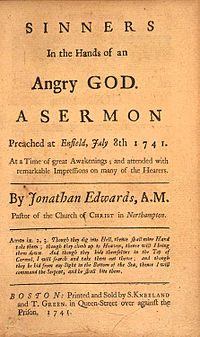
Confidence of sin was the stage that prepared someone to receive salvation, and this stage often lasted weeks or months.[74] When under confidence, nonbelievers realized they were guilty of sin and nether divine condemnation and after faced feelings of sorrow and anguish.[75] When revivalists preached, they emphasized God'southward moral law to highlight the holiness of God and to spark conviction in the unconverted.[76] Jonathan Edwards' sermon "Sinners in the Hands of an Angry God" is an example of such preaching.[ citation needed ]
Equally Calvinists, revivalists also preached the doctrines of original sin and unconditional ballot. Due to the autumn of man, humans are naturally inclined to rebel against God and unable to initiate or merit conservancy, according to the doctrine of original sin. Unconditional election relates to the doctrine of predestination—that before the creation of the world God adamant who would be saved (the elect) on the basis of his own choosing. The preaching of these doctrines resulted in the convicted feeling both guilty and totally helpless, since God was in complete control over whether they would be saved or non.[77]
Revivalists counseled those nether conviction to apply the ways of grace to their lives. These were spiritual disciplines such as prayer, Bible study, church building omnipresence and personal moral improvement. While no deed could produce saving faith, revivalists taught that the means of grace might make conversion more likely.[78]
Revival preaching was controversial amongst Calvinists. Considering Calvinists believed in ballot and predestination, some thought it inappropriate to preach to strangers that they could repent and receive salvation. For some, such preaching was only adequate within their own churches and communities. The revivalists use of "indiscriminate" evangelism—the "practice of extending the gospel promises to anybody in their audiences, without stressing that God redeems only those elected for salvation"—was contrary to these notions. While they preached indiscriminately, however, revivalists connected to assert Calvinist doctrines of ballot and predestination.[79]
Another effect that had to be addressed were the intense concrete and emotional reactions to confidence experienced during the Awakening. Samuel Blair described such responses to his preaching in 1740, "Several would be overcome and fainting; others deeply sobbing, hardly able to comprise, others crying in a well-nigh dolorous manner, many others more than silently weeping. ... And sometimes the soul exercises of some, thought comparatively but very few, would so far affect their bodies, as to occasion some strange, unusual bodily motions."[fourscore] Moderate evangelicals took a cautious approach to this issue, neither encouraging or discouraging these responses, but they recognized that people might express their conviction in unlike ways.[74]
Conversion [edit]
The conviction phase lasted so long because potential converts were waiting to find bear witness of regeneration within their lives. The revivalists believed regeneration or the new birth was non simply an outward profession of faith or conformity to Christianity. They believed it was an instantaneous, supernatural work of the Holy Spirit providing someone with "a new sensation of the beauty of Christ, new desires to love God, and a firm delivery to follow God'due south holy law."[74] The reality of regeneration was discerned through self-examination, and while it occurred instantaneously, a convert might just gradually realize information technology had occurred.[81]
Regeneration was e'er accompanied past saving faith, repentance and love for God—all aspects of the conversion experience, which typically lasted several days or weeks under the guidance of a trained pastor.[82] True conversion began when the mind opened to a new awareness and dear of the gospel bulletin. Following this illumination, converts placed their faith in Christ, depending on him alone for salvation. At the same time, a hatred of sin and a commitment to eliminate it from the eye would have hold, setting the foundation for a life of repentance or turning away from sin. Revivalists distinguished true conversion (which was motivated by honey of God and hatred of sin) from false conversion (which was motivated past fear of hell).[83]
Consolation [edit]
True conversion meant that a person was amid the elect, but fifty-fifty a person with saving organized religion might doubt his ballot and conservancy. Revivalists taught that assurance of conservancy was the product of Christian maturity and sanctification.[84] Converts were encouraged to seek assurance through self-examination of their own spiritual progress. The treatise Religious Angel by Jonathan Edwards was written to help converts examine themselves for the presence of genuine "religious affections" or spiritual desires, such as selfless dearest of God, certitude in the divine inspiration of the gospel, and other Christian virtues.[85]
It was not enough, still, to simply reverberate on past experiences. Revivalists taught that balls could simply be gained through actively seeking to grow in grace and holiness through mortification of sin and utilizing the ways of grace. In Religious Affections, the terminal sign addressed past Edwards was "Christian practise", and it was this sign to which he gave the well-nigh space in his treatise. The search for balls required conscious endeavor on the part of a convert and took months or fifty-fifty years to achieve.[86]
[edit]
Women [edit]
The Awakening played a major role in the lives of women, though they were rarely allowed to preach or take leadership roles.[87] [ page needed ] A deep sense of religious enthusiasm encouraged women, peculiarly to analyze their feelings, share them with other women, and write about them. They became more independent in their decisions, as in the choice of a husband.[88] This introspection led many women to continue diaries or write memoirs. The autobiography of Hannah Heaton (1721–94), a farm wife of N Oasis, Connecticut, tells of her experiences in the Keen Enkindling, her encounters with Satan, her intellectual and spiritual development, and daily life on the farm.[89]
Phillis Wheatley was the kickoff published black female poet, and she was converted to Christianity as a child after she was brought to America. Her behavior were overt in her works; she describes the journey of being taken from a Heathen land to be exposed to Christianity in the colonies in a poem entitled "On Being Brought from Africa to America."[90] [ non-chief source needed ] Wheatley became so influenced by the revivals and particularly George Whitefield that she dedicated a poem to him after his death in which she referred to him every bit an "Impartial Saviour".[91] [ non-primary source needed ] Sarah Osborn adds another layer to the role of women during the Awakening. She was a Rhode Island schoolteacher, and her writings offer a fascinating glimpse into the spiritual and cultural upheaval of the fourth dimension catamenia, including a 1743 memoir, various diaries and letters, and her anonymously published The Nature, Certainty and Evidence of True Christianity (1753).[92]
African Americans [edit]
The First Great Awakening led to changes in Americans' understanding of God, themselves, the globe effectually them, and religion. In the southern Tidewater and Low Country, northern Baptist and Methodist preachers converted both white and black people. Some were enslaved at their fourth dimension of conversion while others were gratis. Caucasians began to welcome dark-skinned individuals into their churches, taking their religious experiences seriously, while also admitting them into agile roles in congregations equally exhorters, deacons, and even preachers, although the last was a rarity.[93]
The message of spiritual equality appealed to many enslaved peoples, and, equally African religious traditions continued to decline in North America, Blackness people accepted Christianity in large numbers for the first fourth dimension.[94]
Evangelical leaders in the southern colonies had to deal with the issue of slavery much more frequently than those in the North. All the same, many leaders of the revivals proclaimed that slaveholders should educate enslaved peoples so that they could become literate and exist able to read and study the Bible. Many Africans were finally provided with some sort of education.[95] [ folio needed ]
George Whitefield's sermons reiterated an egalitarian message, but only translated into a spiritual equality for Africans in the colonies who mostly remained enslaved. Whitefield was known to criticize slaveholders who treated enslaved peoples cruelly and those who did non educate them, merely he had no intention to abolish slavery. He lobbied to take slavery reinstated in Georgia and proceeded to become a slave holder himself.[96] Whitefield shared a common belief held among evangelicals that, after conversion, slaves would be granted true equality in Heaven. Despite his opinion on slavery, Whitefield became influential to many Africans.[97]
Samuel Davies was a Presbyterian minister who later became the quaternary president of Princeton University.[98] He was noted for preaching to African enslaved peoples who converted to Christianity in unusually large numbers, and is credited with the get-go sustained proselytization of enslaved peoples in Virginia.[99] Davies wrote a letter in 1757 in which he refers to the religious zeal of an enslaved man whom he had encountered during his journey. "I am a poor slave, brought into a foreign country, where I never expect to relish my liberty. While I lived in my ain country, I knew nothing of that Jesus I have heard you speak so much about. I lived quite devil-may-care what will become of me when I dice; but I at present come across such a life will never exercise, and I come to you lot, Sir, that you lot may tell me some good things, concerning Jesus Christ, and my Duty to GOD, for I am resolved not to alive any more as I have done."[100]
Davies became accustomed to hearing such excitement from many Black people who were exposed to the revivals. He believed that Black people could achieve cognition equal to white people if given an adequate pedagogy, and he promoted the importance for slaveholders to permit enslaved peoples to get literate so that they could become more familiar with the instructions of the Bible.[101]
The emotional worship of the revivals appealed to many Africans, and African leaders started to emerge from the revivals soon after they converted in substantial numbers. These figures paved the way for the establishment of the first Black congregations and churches in the American colonies.[102] Earlier the American Revolution, the start black Baptist churches were founded in the South in Virginia, Southward Carolina, and Georgia; 2 Black Baptist churches were founded in Petersburg, Virginia.[103]
Scholarly interpretation [edit]
| | This section needs expansion with: more information on how the Great Awakening has been interpreted by scholars overtime. You lot can help by adding to information technology. (February 2018) |
![[icon]](https://upload.wikimedia.org/wikipedia/commons/thumb/1/1c/Wiki_letter_w_cropped.svg/44px-Wiki_letter_w_cropped.svg.png)
The thought of a "great enkindling" has been contested past historian Jon Butler as vague and exaggerated. He suggested that historians abandon the term Great Awakening because the 18th-century revivals were but regional events that occurred in only half of the American colonies and their furnishings on American faith and order were minimal.[104] Historians have debated whether the Awakening had a political impact on the American Revolution which took identify before long afterward. Professor Alan Heimert sees a major impact, just virtually historians think it had only a minor bear on.[105] [106]
See also [edit]
- Second Great Awakening
- Third Great Awakening
- Fourth Nifty Awakening
- American philosophy
References [edit]
Citations [edit]
- ^ a b Sweeney 2005, p. 186: "'Not bad Awakening' is a largely American term for the transatlantic revivals of the eighteenth century. British Christians usually refer to the revivals—collectively and more simply—as 'the evangelical revival.'"
- ^ Ahlstrom 2004, pp. 280–330.
- ^ Taylor 2001, p. 354.
- ^ "Slavery and African American Faith." American Eras. 1997. Encyclopedia.com. (April 10, 2014).
- ^ Bebbington 1989, p. 12.
- ^ Ahlstrom 2004, p. 263.
- ^ Campbell 1996, p. 127.
- ^ Sweeney 2005, p. 36.
- ^ Sweeney 2005, pp. 36–37.
- ^ a b c Bebbington 1989, p. twenty.
- ^ Sweeney 2005, p. 37.
- ^ a b c Smith 2015, p. 110.
- ^ a b Noll 2004, p. 73.
- ^ Kidd 2007, p. 42.
- ^ a b c Sweeney 2005, p. 40.
- ^ Kidd 2007, p. 43.
- ^ Noll 2004, pp. 88–89.
- ^ Noll 2004, pp. 84–85.
- ^ a b Sweeney 2005, p. 39.
- ^ Noll 2004, p. 97.
- ^ Noll 2004, p. 99.
- ^ a b Kidd 2007, p. 44.
- ^ a b Noll 2004, p. 102.
- ^ Kidd 2007, p. 45.
- ^ Smith 2015, p. 112.
- ^ Sweeney 2005, p. 42.
- ^ Hurst, J. F. (1903). "Chapter IX – Social club and Class". John Wesley the Methodist: a obviously account of his life and piece of work. New York: Methodist Book Concern.
- ^ a b c Hylson-Smith, Kenneth (1992). Evangelicals in the Church of England 1734–1984. Bloomsbury. pp. 17–21.
- ^ Stutzman, Paul Fike (January 2011). Recovering the Love Feast: Broadening Our Eucharistic Celebrations. Wipf and Stock Publishers. p. 159. ISBN9781498273176 . Retrieved four January 2017.
- ^ John Wesley, The Works of the Reverend John Wesley, A. G. (1831) "A curt history of Methodism," 2.1. Retrieved on 21 October 2016.
- ^ a b Barr, Josiah Henry (1916). Early Methodists under persecution. Methodist book business organisation.
- ^ On anti-Methodist literary attacks see Brett C. McInelly, "Writing the Revival: The Intersections of Methodism and Literature in the Long 18th Century". Literature Compass 12.1 (2015): 12–21; McInelly, Textual Warfare and the Making of Methodism (Oxford University Printing, 2014).
- ^ Kee et al. 1998, p. 412.
- ^ Smith 2015, p. 70.
- ^ Bebbington 1989, p. 33.
- ^ Smith 2015, p. 1.
- ^ a b c d Smith 2015, p. two.
- ^ a b Ahlstrom 2004, p. 287.
- ^ Kidd 2007, p. thirty.
- ^ Kidd 2007, p. xiv.
- ^ Kidd 2007, p. eight.
- ^ Kidd 2007, pp. 10–xi.
- ^ a b Ahlstrom 2004, p. 269.
- ^ Ahlstrom 2004, p. 270.
- ^ Kidd 2007, p. xiii.
- ^ Ahlstrom 2004, p. 282.
- ^ Noll 2004, pp. 76–78.
- ^ Kidd 2007, pp. xiii–fourteen, 15–16.
- ^ Kidd 2007, pp. 19–xx.
- ^ Kidd 2007, pp. 21–23.
- ^ a b Ahlstrom 2004, p. 271.
- ^ Ahlstrom 2004, p. 283.
- ^ a b c Ahlstrom 2004, p. 284.
- ^ Caldwell 2017, p. 14.
- ^ a b Ahlstrom 2004, p. 285.
- ^ a b Ahlstrom 2004, p. 286.
- ^ Kidd 2007, pp. 28–29.
- ^ Kee et al. 1998, pp. 415–416.
- ^ Ahlstrom 2004, pp. 290–291.
- ^ Ahlstrom 2004, pp. 292–293.
- ^ Ahlstrom 2004, p. 272.
- ^ Smith 2015, p. eight.
- ^ Ahlstrom 2004, p. 293.
- ^ Smith 2015, p. 3.
- ^ Winiarski 2005.
- ^ a b Ahlstrom 2004, p. 273.
- ^ Ahlstrom 2004, p. 275.
- ^ Ahlstrom 2004, p. 289.
- ^ Ahlstrom 2004, p. 290.
- ^ Caldwell 2017, p. 11.
- ^ Campbell 1996, p. 194.
- ^ Caldwell 2017, pp. 6, xx.
- ^ Caldwell 2017, p. 8.
- ^ a b c Caldwell 2017, p. 29.
- ^ Caldwell 2017, p. twenty.
- ^ Caldwell 2017, p. 22.
- ^ Caldwell 2017, pp. 22–24.
- ^ Caldwell 2017, p. 25.
- ^ Sweeney 2005, pp. 48–49.
- ^ Caldwell 2017, p. 28.
- ^ Caldwell 2017, p. thirty.
- ^ Caldwell 2017, p. 42.
- ^ Caldwell 2017, pp. 32–34.
- ^ Caldwell 2017, p. 38.
- ^ Caldwell 2017, p. 39.
- ^ Caldwell 2017, p. 39–41.
- ^ Brekus 1998.
- ^ Matthews 1992, p. 38.
- ^ Lacey 1988.
- ^ Wheatley, Phillis. "On Beingness Brought From Africa to America." (London: 1773). Poems By Phillis Wheatley.
- ^ Wheatley, Phillis. "An Elegiac Poem On the Decease of that celebrated Divine, and eminent Servant of Jesus Christ, the Reverend and Learned Mr. George Whitefield." (London: 1773). Massachusetts Historical Society.
- ^ Brekus 2013.
- ^ Kidd 2008, p. 19.
- ^ Lambert 2002.
- ^ Butler 1990.
- ^ Whitefield, George. To the Inhabitants of Maryland, Virginia, North and South Carolina (Philadelphia: 1740); quoted in Kidd 2008, pp. 112–115
- ^ Kidd 2007, p. 217.
- ^ Presidents of Princeton from princeton.edu. Retrieved April 8, 2012.
- ^ "Samuel Davies and the Transatlantic Campaign for Slave Literacy in Virginia," Archived 2016-03-04 at the Wayback Car an abridged version of Jeffrey H. Richards' article. from historicpolegreen.org. Retrieved April 8, 2012.
- ^ Letters from the Reverend Samuel Davies (London, 1757), p. 19.
- ^ Lambert 2002, p. 14.
- ^ Butler, Wacker & Balmer 2003, p. 112–113.
- ^ Brooks 2000.
- ^ Butler 1982, pp. 322–323.
- ^ Heimert 1966.
- ^ Goff & Heimert 1998.
Bibliography [edit]
- Ahlstrom, Sydney E. (2004) [1972]. A Religious History of the American People (2nd ed.). Yale Academy Printing. ISBN0-385-11164-9.
- Bebbington, David W. (1989). Evangelicalism in Modernistic Uk: A History from the 1730s to the 1980s. Routledge. ISBN0-415-10464-5.
- Brekus, Catherine A. (1998). Strangers & Pilgrims: Female Preaching in America, 1740–1845. Academy of North Carolina Press. ISBN9780807824412.
- Brekus, Catherine A. (2013). Sarah Osborn's Globe: The Rise of Evangelical Christianity in Early America. Yale University Press. ISBN9780300188325.
- Brooks, Walter Henderson (2000) [1910]. The Argent Bluff Church: A History of Negro Baptist Churches in America (electronic ed.). University of North Carolina at Chapel Hill.
- Butler, Jon (September 1982). "Enthusiasm Described and Decried: The Great Awakening every bit Interpretative Fiction". Journal of American History. 69 (2): 305–325. doi:10.2307/1893821. JSTOR 1893821.
- Butler, Jon (1990). Awash in a Sea of Faith: Christianizing the American People . Studies in Cultural History. Harvard Academy Printing. ISBN978-0674056015.
- Butler, Jon; Wacker, Grant; Balmer, Randall (2003). Religion in American Life: A Short History. Oxford University Press. ISBN978-0199832699.
- Caldwell, Robert West., III (2017). Theologies of the American Revivalists: From Whitefield to Finney. InterVarsity Press. ISBN9780830851645.
- Campbell, Ted A. (1996). Christian Confessions: A Historical Introduction. Westminster John Knox Printing. ISBN9780664256500.
- Goff, Philip; Heimert, Alan (December 1998). "Revivals and Revolution: Historiographic Turns since Alan Heimert's Religion and the American Mind". Church History. 67 (4): 695–721. doi:10.2307/3169849. JSTOR 3169849.
- Heimert, Alan (1966). Religion and the American Mind: From the Groovy Awakening to the Revolution . Harvard Academy Press.
- Kee, Howard C.; Frost, Jerry W.; Albu, Emily; Lindberg, Carter; Robert, Dana L. (1998). Christianity: A Social and Cultural History (2d ed.). Upper Saddle River, New Bailiwick of jersey: Prentice Hall. ISBN0135780713.
- Kidd, Thomas S. (2007). The Dandy Enkindling: The Roots of Evangelical Christianity in Colonial America. Yale University Press. ISBN978-0-300-11887-2.
- Kidd, Thomas S. (2008). The Bang-up Awakening: A Cursory History with Documents. Bedford Series in History and Culture. Bedford/ St. Martin's. ISBN9780312452254.
- Lacey, Barbara E. (Apr 1988). "The World of Hannah Heaton: The Autobiography of an Eighteenth-Century Connecticut Subcontract Adult female". William and Mary Quarterly. Omohundro Institute of Early American History and Culture. 45 (2): 280–304. doi:10.2307/1922328. JSTOR 1922328.
- Lambert, Frank (Winter 2002). "'I Saw the Book Talk': Slave Readings of the Start Nifty Awakening". The Periodical of African American History. 87 (1): 12–25. doi:10.1086/JAAHv87n1p12. JSTOR 1562488.
- Matthews, Glenna (1992). The Rise of Public Woman: Woman's Power and Woman's Place in the Us, 1630–1970. Oxford University Press. ISBN9780199951314.
- Noll, Mark A. (2004), The Rise of Evangelicalism: The Age of Edwards, Whitefield and the Wesleys, Inter-Varsity, ISBNane-84474-001-three
- Smith, Howard John (2015). The First Great Enkindling: Redefining Religion in British America, 1725–1775. Fairleigh Dickinson Academy Press. ISBN978-1-61147-714-half-dozen.
- Stout, Harry (1991). The Divine Dramatist: George Whitefield and the Rise of Modern Evangelicalism. Library of Religious Biography. William B. Eerdmans Publishing Company. ISBN9780802801548.
- Sweeney, Douglas A. (2005). The American Evangelical Story: A History of the Movement . Bakery Academic. ISBN978-one-58558-382-9.
- Taylor, Alan (2001). American Colonies: The Settling of North America. Penguin Books. ISBN9780142002100.
- Winiarski, Douglas L. (2005). "Jonathan Edwards, Enthusiast? Radical Revivalism and the Not bad Awakening in the Connecticut Valley". Church History. 74 (4): 683–739. doi:10.1017/s0009640700100861. JSTOR 27644661.
Further reading [edit]
Scholarly studies [edit]
- Bonomi, Patricia U. Nether the Cope of Heaven: Organized religion, Society, and Politics in Colonial America Oxford Academy Press, 1988
- Bumsted, J. M. "What Must I Do to Be Saved?": The Great Enkindling in Colonial America 1976, Thomson Publishing, ISBN 0-03-086651-0.
- Choiński, Michał. The Rhetoric of the Revival: The Language of the Great Awakening Preachers. 2016, Vandenhoeck & Ruprecht, ISBN 978-3-525-56023-5.
- Conforti, Joseph A. Jonathan Edwards, Religious Tradition and American Civilisation University of North Carolina Printing. 1995.
- Fisher, Linford D. The Indian Dandy Awakening: Religion and the Shaping of Native Cultures in Early America Oxford University Printing, 2012.
- Gaustad, Edwin S. The Dandy Enkindling in New England (1957)
- Gaustad, Edwin S. "The Theological Effects of the Great Awakening in New England," The Mississippi Valley Historical Review, Vol. forty, No. 4. (Mar., 1954), pp. 681–706. JSTOR 1895863.
- Goen, C. C. Revivalism and Separatism in New England, 1740–1800: Strict Congregationalists and Dissever Baptists in the Slap-up Awakening 1987, Wesleyan University Printing, ISBN 0-8195-6133-9.
- Hatch, Nathan O. The Democratization of American Christianity 1989.
- Isaac, Rhys. The Transformation of Virginia, 1740–1790 1982, emphasis on Baptists
- Kidd, Thomas Southward. God of Liberty: A Religious History of the American Revolution (2010).
- Lambert, Frank. Pedlar in Divinity: George Whitefield and the Transatlantic Revivals; (1994)
- Lambert, Frank. "The First Great Awakening: Whose interpretive fiction?" The New England Quarterly, vol.68, no.4, pp. 650, 1995
- Lambert, Frank. Inventing the "Great Enkindling" (1998).
- McLoughlin, William Yard. Revivals, Awakenings, and Reform: An Essay on Religion and Social Change in America, 1607–1977 (1978).
- Schmidt, Leigh Eric. Holy Fairs: Scotland and the Making of American Revivalism (2001)
- Schmotter, James W. "The Irony of Clerical Professionalism: New England's Congregational Ministers and the Great Awakening", American Quarterly, 31 (1979), a statistical written report JSTOR 2712305
- Smith, John Howard. The Showtime Bully Awakening: Redefining Faith in British America, 1725–1775 (Rowman & Littlefield, 2015) ISBN 978-1611477160
- Smith, Lisa. The Outset Great Awakening in Colonial American Newspapers: A Shifting Story (2012)
- Ward, W. R. (2002). The Protestant Evangelical Awakening. Cambridge University Printing. ISBN0521892325. .
- Winiarski, Douglas L. Darkness Falls on the Land of Light: Experiencing Religious Awakenings in Eighteenth-Century New England (U of North Carolina Printing, 2017). xxiv, 607 pp.
Historiography [edit]
- McLoughlin, William G. "Essay Review: the American Revolution as a Religious Revival: 'The Millennium in One State.'" New England Quarterly 1967 40(1): 99–110. JSTOR 363855
Primary sources [edit]
- Jonathan Edwards, (C. Goen, editor) The Great-Enkindling: A True-blue Narrative Collected contemporary comments and letters; 1972, Yale University Press, ISBN 0-300-01437-6.
- Alan Heimert and Perry Miller ed.; The Great Awakening: Documents Illustrating the Crisis and Its Consequences 1967
- Davies, Samuel. Sermons on Of import Subjects. Edited by Albert Barnes. 3 vols. 1845. reprint 1967
- Gillies, John. Memoirs of Rev. George Whitefield. New Haven, CN: Whitmore and Buckingham, and H. Mansfield, 1834.
- Jarratt, Devereux. The Life of the Reverend Devereux Jarratt. Religion in America, ed. Edwin S. Gaustad. New York, Arno, 1969.
- Whitefield, George. George Whitefield's Journals. Edited by Iain Murray. London: Imprint of Truth Trust, 1960.
- Whitefield, George. Messages of George Whitefield. Edited by S. M. Houghton. Edinburgh, U.k.: Banner of Truth Trust, 1976.
External links [edit]
- Lesson plan on First Great Awakening
- The Great Awakening Comes to Weathersfield, Connecticut: Nathan Cole's Spiritual Travels
- "I Believe It Is Because I Am a Poor Indian": Samsom Occom's Life every bit an Indian Minister
- "The Joseph Bellamy House: The Neat Awakening in Puritan New England", a National Park Service Instruction with Historic Places (TwHP) lesson plan
- Edwards, "Sinners in the Hands of an Angry God" text
Source: https://en.wikipedia.org/wiki/First_Great_Awakening
0 Response to "First Great Awakening Free Dolphins Teacher Miss Smith for the Weather Again"
Post a Comment